Project Info
Building Teacher Capacity for Critical AI Engagement
 The AI2PI Teacher Academy tackles one of education's most pressing challenges: preparing teachers to navigate the transformative impact of artificial intelligence. While Generative AI reshapes learning at unprecedented speed, teachers often lack comprehensive orientation to critically assess and ethically implement these technologies. We envision schools where educators can critically engage with AI as reflective practitioners, making informed, pedagogically sound decisions in complex digital-material contexts. Through design-based research and international collaboration, we create context-adapted training modules that build transnational communities of practice. By supporting teachers as essential mediators in the AI-enhanced classroom, we aim to shift the teaching profession from reactive to proactive engagement with educational technology.
THE PROJECT
 Official Title: From Artificial Intelligence to Pedagogical Innovation – AI2PI Teacher Academy
Project ID: 101196121
Funding: EACEA (European Education and Culture Executive Agency)
Programme: ERASMUS2027 (Call: Erasmus+ Teacher Academies 2024)
Duration: April 1, 2025 – March 31, 2028 (36 months)
Budget: €1,493,901
Coordinator: Humboldt-Universität zu Berlin (Germany)
Consortium Partners:
- 7 Universities: Berlin (DE), Turku (FI), Bolzano (IT), Minho/Braga (PT), Innsbruck (AT), Kaunas (LT), Umeå (SE)
- 2 Continuing Professional Development Providers: PH Tirol (AT), University of Minho (PT)
- 1 Research Institute: German Research Center for Artificial Intelligence - DFKI (DE)
- 1 Municipality: Salo (FI) + 7+ training schools across partner countries
PROJECT GOALS
The AI2PI Teacher Academy seeks to empower educators with the skills to critically engage with AI technologies by integrating AI reflection into pedagogical practices. Our goals are to:
- Develop frameworks for educators to evaluate AI tools' quality and impact on teaching and learning
- Promote reflective thinking and informed decision-making in the use of AI technologies in the classroom
- Provide ongoing professional development to help teachers adapt to AI's evolving role in education
- Ensure AI tools are used ethically, equitably, and effectively to improve teaching and learning for all students
OUR APPROACH
Design-Based Research Methodology: Iterative cycles ensuring solutions are research-grounded and practice-ready
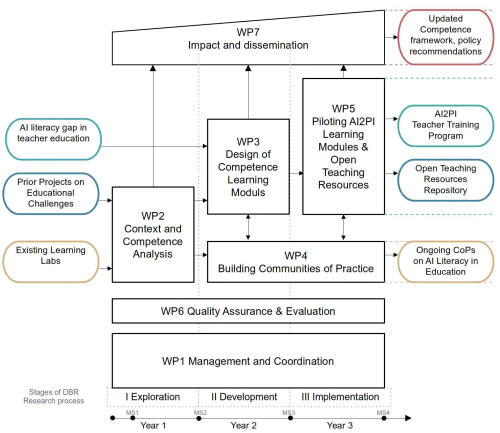
The project follows a three-phase design-based research approach spanning 36 months:
Phase I: Exploration (Year 1)
Context and competence analysis across seven partner countries, identifying gaps in AI literacy frameworks and building on prior educational projects and existing learning labs.
Phase II: Development (Year 2)
Co-creation of competence-based learning modules, establishing communities of practice, and developing the AI2PI training infrastructure.
Phase III: Implementation (Year 3)
Piloting training modules with 1,000+ teachers, building open teaching resources, and developing policy recommendations.
All phases are supported by continuous project management (WP1), quality assurance and evaluation (WP6), and impact dissemination (WP7).
EXPECTED IMPACT
Key Outcomes:
- Enhanced teacher confidence in critically evaluating and implementing AI tools
- Active international communities driving continuous pedagogical innovation
- Open Educational Resources accessible beyond project lifetime
- Strengthened attractiveness of the teaching profession in the digital age
TIMELINE
Key Milestones:
- Apr 2025: Project Launch & Kickoff
- Feb 2026: AI Literacy Competency Framework
- Mar 2027: Piloted Course Modules
- Apr 2028: Comprehensive Course Materials for Communities of Teachers (in-service and pre-service)